
Global markets trends, inflation, release of industrial output data and quarterly earnings will dictate movement of the equity benchmarks this week, analysts said, adding that volatility might continue amid slew of announcements of macroeconomic data at the global level too. Moreover, foreign fund movement, crude oil prices and trend in rupee would also act as major drivers for the equity market, they added. "The direction of global equity markets along with movement in dollar index and crude oil prices will continue to dominate while inflation numbers of the USA on May 11 and inflation and IIP numbers of India on May 12 will also cause volatility in the market," said Santosh Meena, head of research, Swastika Investmart Ltd.

From the Sensex basket, Infosys, IndusInd Bank, Bajaj Finserv, Wipro, HCL Technologies, Bajaj Finance, Tech Mahindra, Tata Consultancy Services, and Larsen & Toubro were the major laggards. Titan Company, Hindustan Unilever, HDFC Bank, Maruti, ITC, Power Grid and Reliance Industries were the gainers.
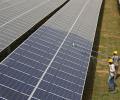
For India to reach its bold target of having net-zero emissions by 2070, the country's solar power capacity would have to rise to over 5,600 GW, coal use particularly in the power sector will have to drop by 99 per cent by 2060 and crude oil would need to peak by 2050 and fall substantially by 90 per cent in the two decades thereafter, CEEW India has said. Prime Minister Narendra Modi on Monday surprised delegates at the COP26 climate summit with a bold pledge to cutting emissions at the world's third-biggest emitter to net-zero by 2070. Council on Energy, Environment and Water, a Delhi-based not-for-profit policy research institution, said, "The economic cost of India's net-zero 2070 transition (would be) over USD 13,000 billion between 2030 and 2100."

The 30-share BSE Sensex surged by 477.24 points or 0.83 per cent to close at more than one-week high of 57,897.48. As many as 28 of its constituents closed with gains while two declined. The broad-based Nifty of the National Stock Exchange rose by 147.20 points or 0.86 per cent to settle 17,233.45, tracking gains in Sun Pharma, Asian Paints, and Reliance Industries.

Larsen & Toubro, Axis Bank, Reliance Industries, UltraTech Cement, Mahindra & Mahindra, IndusInd Bank, ICICI Bank and Tata Steel were the other big gainers. Sun Pharma, HCL Technologies, Asian Paints, Nestle and Infosys were the laggards.

India on Monday said that it will follow up its suggestion on having a price band for crude oil once the producing nations reflect on the idea, even as it asked them to step up oil output.

If 4,000 workers could work round the clock for the construction of the new Parliament building, then there is no reason why all infrastructure projects too cannot follow that model, asserts Dr Sudhir Bisht.

The faster-than-expected rise in interest rates by the US Federal Reserve (US Fed) shook global financial markets in early 2022. And now the ongoing war between Russia and Ukraine has lifted commodity prices, with Brent crude oil hitting a 14-year high of $139 a barrel in intraday trade. All these developments have sent the equity markets across the world into a tailspin.

The talks took place on the sidelines of the G-20 foreign ministers' meeting in the Indonesian city of Bali.

Costlier oil due to rising conflict in Iraq threatens to hurt the India economy that is already battling price rise and slowing growth.

'Honoured to call on HRH Crown Prince Mohammed bin Salman in Jeddah this evening. Conveyed the warm greetings of PM @narendramodi.'

From the Sensex basket, Kotak Mahindra Bank jumped 5 per cent after the company reported a 25 per cent growth in its March quarter net profit at Rs 5,302 crore, limited by a drop in the core income due to narrow interest margins. Tata Consultancy Services, Hindustan Unilever, Mahindra & Mahindra, Sun Pharma, Tech Mahindra and IndusInd Bank were among the other major gainers. Titan tanked 7 per cent after its March quarter earnings failed to cheer investors.

India's economic growth is now 'extremely fragile' and needs all the support that it can get, as private consumption and capital investment are yet to pick up, RBI Monetary Policy Committee (MPC) member Jayanth R Varma said on Friday. Varma further said out of the four engines of growth for the economy, exports and government spending supported the Indian economy through the pandemic, but other engines need to pick up the baton now. " I like to think in terms of the four engines of growth for the economy: exports, government spending, capital investment and private consumption. "...while exports cannot be the main driver of growth because of the global slowdown, government spending is necessarily limited by fiscal constraints," he told PTI.
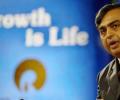
The firm earned $11.6 on turning every barrel of crude oil into fuel in the quarter.

Reliance Industries will sell 20 per cent stake in its oil and chemicals business to Saudi oil giant Aramco for about $ 15 billion and nearly half of its fuel retail business to BP of UK for Rs 7,000 crore. Aramco, the world's biggest crude exporter, will also supply Reliance's twin-refineries at Jamnagar in Gujarat with 7,00,000 barrels of oil a day on a long-term basis, Ambani said.

Consumption-related stocks, such as hotels, and quick service restaurants (QSRs), have been hitting the ball out of the park ahead. On the other hand, the Miss World Pageant scheduled for later this year in New Delhi, too, could provide some tailwind to these stocks, especially hotels and aviation. However, analysts suggest investors put their best foot forward and buy these counters only on a decline given the recent rally and economic headwinds.

'If you look at the order books of capital equipment companies or money deployed on the ground, there is forward movement in terms of actual investment by the private sector.'

Why does the world's fastest-growing major consumer of energy fail to attract investments in oil and gas? This is a question worth pondering after private sector conglomerate Reliance Industries Ltd (RIL) failed to close a $15-billion downstream asset deal with Saudi Arabia's national oil company, Aramco. It's understandable if multi-billion dollar investments in oil and gas projects or deals involving state companies that need to traverse a complex bureaucracy at state and federal levels and the corridors of ministries unravel. However, Mukesh Ambani-run RIL, India's most successful energy company, is not typically known to fumble on closing deals (Ambani closed deals worth around Rs 2 trillion early last year in telecom and retail with blue chip investors).

The BSE Sensex maintained its winning run for the fourth session on the trot on Wednesday to reclaim the 60,000-level after a gap of over four months as investors remained upbeat amid softening crude oil prices and persistent foreign fund inflows. A strengthening rupee and positive Asian markets further bolstered sentiment, traders said. The 30-share BSE benchmark jumped 417.92 points or 0.70 per cent to settle at 60,260.13 -- closing above the psychologically key 60,000-mark for the first time since April 5 this year.

Inflation to peak in the current quarter within tolerance band, moderating in the second half of next fiscal, says central bank.
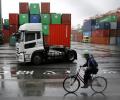
Imports rise at highest pace in more than 2 years as crude oil price spikes.
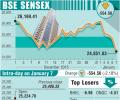
The S&P BSE Sensex plunged 555 points to end at 24,852.

Investors attribute some of the growth in Indian stocks, that saw Bombay's benchmark BSE index rise nearly a third in 2014, to the election of a pro-business government in May, under Prime Minister Narendra Modi.
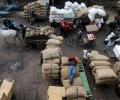
The economy may grow by around 7 per cent this financial year as estimated by the Monetary Policy Committee (MPC) of the Reserve Bank of India (RBI), say economists with various organisations. The first advance estimates for 2023-24 will be released on Friday by the National Statistical Organisation (NSO), an exercise done for calculating ratios such as the fiscal deficit. The interim Budget will be presented on February 1.

The sweeping economic sanctions on Russia - the second largest producer of crude oil - following its invasion of Ukraine late last month can cull global and domestic growth along with the added pains of higher inflation and currency depreciation, RBI Deputy Governor Michael Patra has said. And if the war lingers on, it can even lead to deglobalisation and even a recession, he added. The ongoing war has only added a whole new dimension to the outlook, and in fact, a weighty downside, Patra said in a lecture at the industry lobby IMC on Friday evening.

Global funds, according to Christopher Wood, global head of equity strategy at Jefferies, are now beginning to pay more attention to India with the market now offering 30 companies with a market capitalisation over $25 billion.

The sanctions have a singular purpose, denying the world's largest state sponsor of terrorists the capacity to do things like they did this past couple weeks, attempted assassination campaign in the heart of Europe, said US Secretary of State Mike Pompeo.

Equity benchmarks Sensex and Nifty halted their five-day rally on Tuesday and settled deep in the red, mirroring weak global markets, with decline in index heavyweights Reliance Industries, Infosys and HDFC Bank. Despite opening with gains of over 200 points, the 30-share Sensex turned highly volatile and tumbled 709.17 points or 1.26 per cent to close at 55,776.85. During the day, the benchmark index plunged 1,067.07 points or 1.88 per cent to 55,418.95. The broader NSE Nifty also declined 208.30 points or 1.23 per cent to close at 16,663.

Some of these nations are India's biggest export market. India is also dependent on these countries to meet its energy needs.
An oil spill is the release of a liquid petroleum hydrocarbon into the environment, especially marine areas, due to human activity, and is a form of pollution.

The company's revenue fell to Rs 67,470 crore (Rs 674.7 billion).

Reliance Industries on Friday reported a 4.5 per cent drop in its December quarter net profit at Rs 5,256 crore (Rs 52.56 billion).

India has asked refiners that owe about $6.5 billion to Iran for oil imports to build up dollar and euro balances to avoid downward pressure on the rupee if six world powers and Tehran reach a final nuclear deal.

tailwinds of a remarkable year and handsome investor returns, Indian equities are set for an eventful journey in 2024, with a slew of local and global cues -- varying from interest rates to Lok Sabha polls to geopolitical happenings. Analysts are of the view that the bull run in the domestic equity market will continue, and over the next 3-6 months, the benchmark indices -- Sensex and Nifty -- could climb up to 7 per cent. In 2023, the 30-share BSE Sensex jumped 11,399.52 points or 18.73 per cent, and the NSE Nifty climbed 3,626.1 points or 20 per cent.

'Elections are fought to win.' 'In our party, the leadership takes the final decision, and our leaders are very clear about it.'
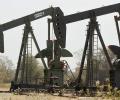
India is the third largest consumer of petroleum products, after the US and China.

External Affairs Minister Salman Khurshid on Wednesday left for Iraq on a two-day visit aimed at deepening India's ties with the oil-rich Arab country.Khurshid, the first Indian external affairs minister to visit Iraq in last 23 years, will hold talks with his Iraqi counterpart Hoshiyar Zebari and discuss bilateral, regional and international issues of mutual interest.

Price said India's relationship with Russia developed over several decades.
 © 2026 Rediff.com - Investor Information - Advertise with us - Disclaimer - Privacy Policy - Sitemap - Feedback - About us - Terms of use - Grievances